

All blog posts
Explore the world of design and learn how to create visually stunning artwork.
Real Estate Photography Camera Settings: The Complete 2026 Guide
June 5, 2026 | by Ian
Real Estate Photographer San Diego: The Complete Hiring Guide (2026)
June 4, 2026 | by Ian
Real Estate Photography Philadelphia: The Complete Agent’s Guide (2026)
June 3, 2026 | by Ian
Real Estate Photographer Phoenix: The Complete Agent’s Hiring Guide (2026)
June 2, 2026 | by Ian
Real Estate Photography Chicago: Complete Guide for Agents [2026]
June 2, 2026 | by Ian
Real Estate Photography Tips: The Practical Photographer’s Playbook (2026)
May 28, 2026 | by Ian

Becoming a Professional Real Estate Photographer: A Comprehensive Guide
December 22, 2023 | by therealtyphotographer.com

3D Real Estate Photography: The Complete Photographer’s Guide to Equipment, Pricing, and Workflow (2026)
Quick Answer:
3D real estate photography uses a specialized 360-degree camera or LiDAR scanner to capture a property so buyers can take an interactive walkthrough tour online. Rather than viewing static photos, they navigate through rooms on their screen as if walking the space themselves. Photographers offer 3D tours as a premium add-on alongside standard listing photos, typically charging $75-$300 extra per shoot depending on property size and platform.
Seven percent of buyers now purchase a home based solely on a virtual tour, without ever stepping inside. That figure comes straight from the National Association of Realtors Confidence Index, and it should change how you think about your service menu. A buyer relocating from another state, a busy professional narrowing a shortlist, an investor scanning a dozen listings before breakfast: these people are closing on properties they experienced entirely through a screen.
For photographers, that shift carries a clear signal. 3D tours are no longer a luxury service that a handful of high-end agents request. They are becoming table stakes on any listing that matters, and the agents who understand this are willing to pay a premium to the photographer who can deliver. A standard photo shoot might net you $150 to $250. Add a 3D tour to that same appointment and you can walk away with an extra $75 to $300 for perhaps 30 additional minutes of on-site work.
This guide covers everything you need to add 3D tours to your business: the technology behind them, the cameras at every price tier, the platforms where tours live, how to price for real profit, and a full shoot-to-delivery workflow. By the end you will know exactly what to buy, what to charge, and how to land your first clients.
What Is 3D Real Estate Photography?
3D real estate photography captures a property from a series of fixed positions and stitches those captures into a single navigable model. Two core technologies make this possible. The first is 360-degree photographic capture, where a camera records a full spherical image from each position and software knits the spheres together into a connected space. The second is LiDAR scanning, which fires laser pulses to measure the exact distance to every surface in a room, building a precise geometric map that the tour is draped over. Higher-end systems like the Matterport Pro3 use LiDAR for accuracy; consumer 360 cameras rely on photographic depth estimation, which is good enough for most residential work.
The signature output is the interactive walkthrough, where a viewer clicks from one position to the next as if strolling through the home. From that same scan data, the software generates two more views buyers love. The “dollhouse” view lifts the roof off and rotates the entire home in three dimensions, so a buyer instantly grasps the layout and flow. The floor plan view flattens the scan into a top-down schematic with room dimensions, which agents attach directly to their listings. All three come from a single capture session, which is what makes 3D so efficient once you learn the process.
Depending on your camera and platform, a single shoot can produce four deliverables: the interactive tour, a 2D or 3D floor plan, a set of HDR still photos pulled from the panoramas, and, on advanced systems, a raw point cloud that architects or contractors can use for measurements. You will not sell every output on every job, but knowing what a scan can generate lets you build tiered packages and upsell the right clients.
The Case for Adding 3D Tours to Your Services
Consider that NAR figure again: 7% of buyers commit to a purchase from a virtual tour alone. On a listing pool of any real size, that is a meaningful slice of transactions where the 3D tour did the heavy lifting. Agents know this. They see the analytics on listing engagement, and they know that a home with an immersive tour holds a buyer’s attention far longer than a photo carousel. That attention translates to showings, offers, and faster closings, which is the currency agents actually care about.
So who pays for 3D, and why? Luxury listings top the list. When a home is priced at seven figures, the marketing budget expands accordingly, and a 3D tour is an expected part of the package. Our guide to luxury real estate photography goes deeper on serving that tier, but the short version is that these agents rarely blink at a $300 to $600 tour fee. Out-of-town and relocation buyers are the second driver: an agent representing a seller in a market that draws remote buyers needs a tour that lets those buyers vet the home before booking a flight. New construction and vacant homes are a natural third, since there is nothing to declutter and the space photographs cleanly.
The competitive angle matters just as much as the demand. Plenty of photographers in your market shoot solid stills. Far fewer offer polished 3D tours, and fewer still can speak intelligently about which platform suits which listing. When you show up able to deliver both a beautiful photo set and an interactive walkthrough, you stop competing on price and start competing on capability. That is a much better place to sell from.
Types of 3D Real Estate Photography
Interactive Walkthrough Tours (Matterport-style)
This is what most people picture when they hear “3D tour.” The viewer moves through the home position by position, looks in any direction, and pops out to the dollhouse or floor plan view whenever they want to reorient. Matterport pioneered this format and remains the name agents recognize, which is why “matterport real estate” is practically shorthand for the whole category. These tours feel the most like actually walking the property, and they are the highest-value deliverable you can sell.
360-Degree Panoramic Tours
A step simpler than a full walkthrough, a 360 panoramic tour links a series of spherical photos with navigation hotspots. The viewer clicks a hotspot to jump to the next room and can spin around within each panorama. This is the workhorse of 360 real estate photography and pairs well with budget 360 cameras. The experience is slightly less seamless than a LiDAR-driven walkthrough, but for mid-market listings the difference rarely bothers buyers, and your capture and processing time drops considerably.
3D Floor Plans and Schematic Floor Plans
Floor plans are the quiet workhorse of a 3d virtual tour real estate package. A schematic floor plan is a clean top-down diagram with room labels and dimensions; a 3D floor plan renders those same rooms with a sense of depth and furniture placement. Agents attach these directly to MLS listings, and buyers use them to judge whether their furniture fits before they ever visit. Platforms like iGUIDE bundle ANSI-standard floor plans with every scan, which turns a routine tour into a much stronger listing asset.
AI-Enhanced Virtual Tours
The newest category leans on software to fill gaps and polish output. AI tools now generate floor plans from smartphone captures, auto-correct exposure across panoramas, remove minor clutter, and even suggest virtual furniture placement. These features lower the barrier to entry and speed up post-production, though they work best as an accelerant on top of a clean capture rather than a rescue for a sloppy one. Expect this category to keep expanding, and expect agents to start asking for it by name.
Equipment: Choosing Your 3D Camera
Your camera choice sets the ceiling on quality and the floor on cost. Here are the four cameras we suggest evaluating, spanning the full range from professional flagship to entry-level experiment.
| Camera | Price | Best For | Platform Compatibility |
|---|---|---|---|
| Matterport Pro3 | ~$5,995 | High-volume professionals, full Matterport ecosystem | Matterport only |
| Ricoh Theta Z1 | ~$1,000 | Mid-tier photographers, works with multiple platforms | Matterport, iGUIDE, Zillow, most |
| Insta360 RS 1-inch | ~$649 | Budget-conscious starters, versatile workflow | Most platforms via third-party |
| GoPro Max | ~$399 | Entry-level experimentation | Limited; Zillow 3D Home |
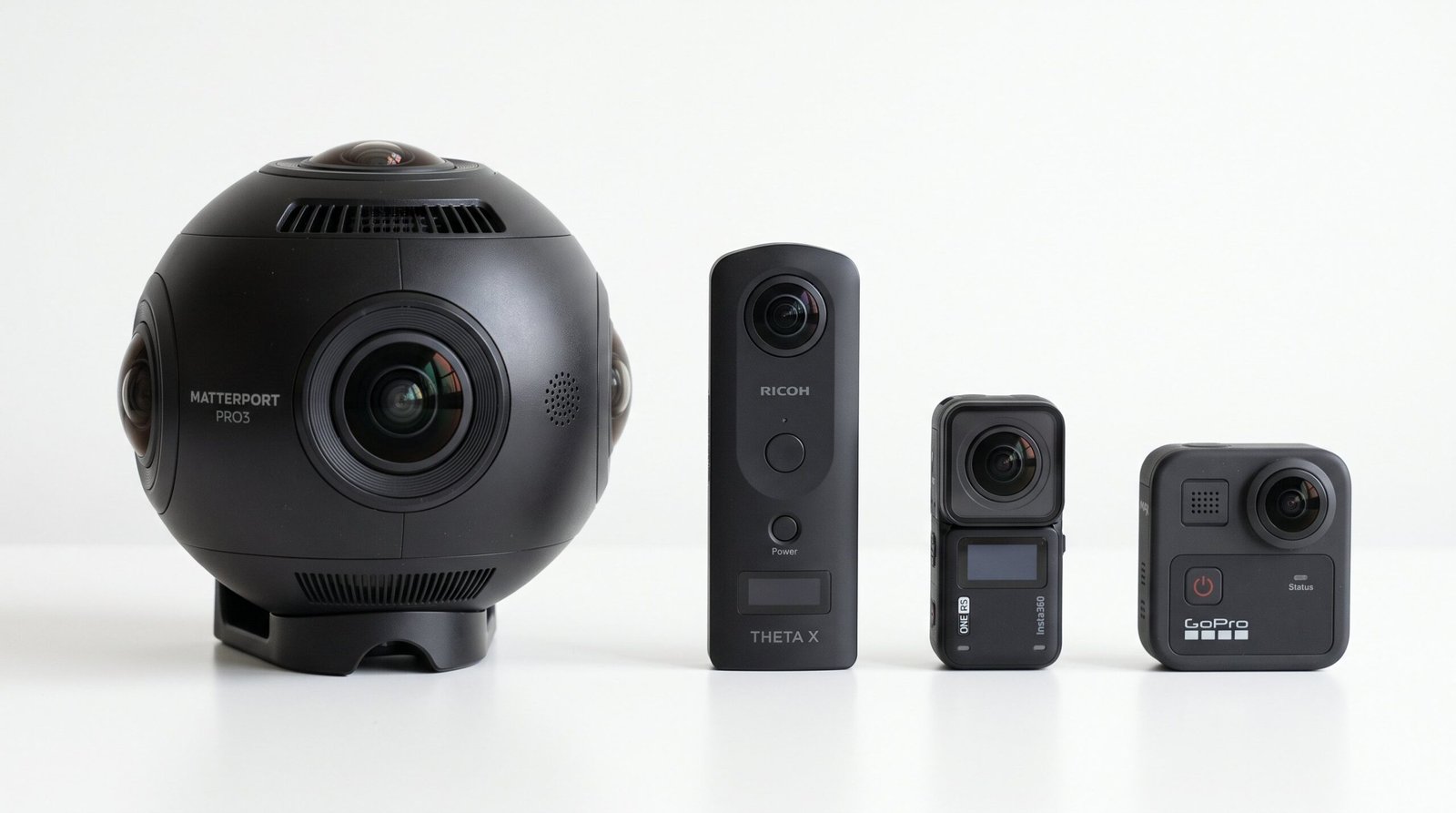
The Matterport Pro3 at roughly $5,995 is the flagship for a reason. Its LiDAR sensor captures deadly accurate geometry indoors and out, scans in a fraction of the time of a 360 camera, and feeds directly into Matterport’s polished ecosystem that agents already trust. The catch is the walled garden: the Pro3 only works with Matterport, so you are committing to their platform and subscription for the life of the camera.
The Ricoh Theta Z1 around $1,000 is the sweet spot for most serious photographers. Its 1-inch sensors produce genuinely clean HDR panoramas, and critically, it plays nicely with Matterport, iGUIDE, Zillow 3D Home, and nearly every other platform. That flexibility means you can chase whichever platform a given agent prefers without buying new hardware. For matterport real estate photography at a fraction of the Pro3’s cost, the Z1 is the pragmatic pick.
The Insta360 RS 1-inch at about $649 delivers surprisingly strong image quality for the price and doubles as a capable action and marketing camera when you are not scanning. It reaches most platforms through third-party workflows, so it takes a bit more setup than a native Matterport device, but for a photographer testing whether 3D demand exists in their market, the value is hard to beat.
The GoPro Max at roughly $399 is the true entry point. It is limited in platform support and leans on Zillow 3D Home for tour creation, but it lets you experiment with 360 capture for the cost of a modest lens. Do not expect luxury-listing polish from it; do expect a low-risk way to learn the format.
One more option costs nothing if you already own it: a recent iPhone Pro with a built-in LiDAR sensor. Apps like the Zillow 3D Home app and several Matterport-compatible capture tools turn the phone into a functional scanner. The output will not match a Pro3, but as a free starting point to build sample tours and gauge interest, it is genuinely useful. For a broader look at how a 3D rig fits into your kit, see our real estate photography equipment guide.
Software and Platforms: Where Your Tours Live
The camera captures the data, but the platform hosts the tour, generates the floor plan, and gives the agent a link to share. Your platform choice affects your monthly overhead as much as your camera choice affects your upfront cost. Here are the four we suggest comparing.
| Platform | Monthly Cost | Active Spaces | Distinctive Feature |
|---|---|---|---|
| Matterport | $14-$99/mo (Starter-Professional) | 5-50 spaces | Industry standard, agent familiarity, Google Street View sync |
| iGUIDE | ~$75/scan (no subscription) | Unlimited hosting | ANSI-standard floor plans included, pay-per-scan model |
| Zillow 3D Home | Free | Unlimited | Direct Zillow listing integration, uses smartphone |
| Asteroom | $12-$24/mo | 50-unlimited | Affordable, works with DSLR + adapter |
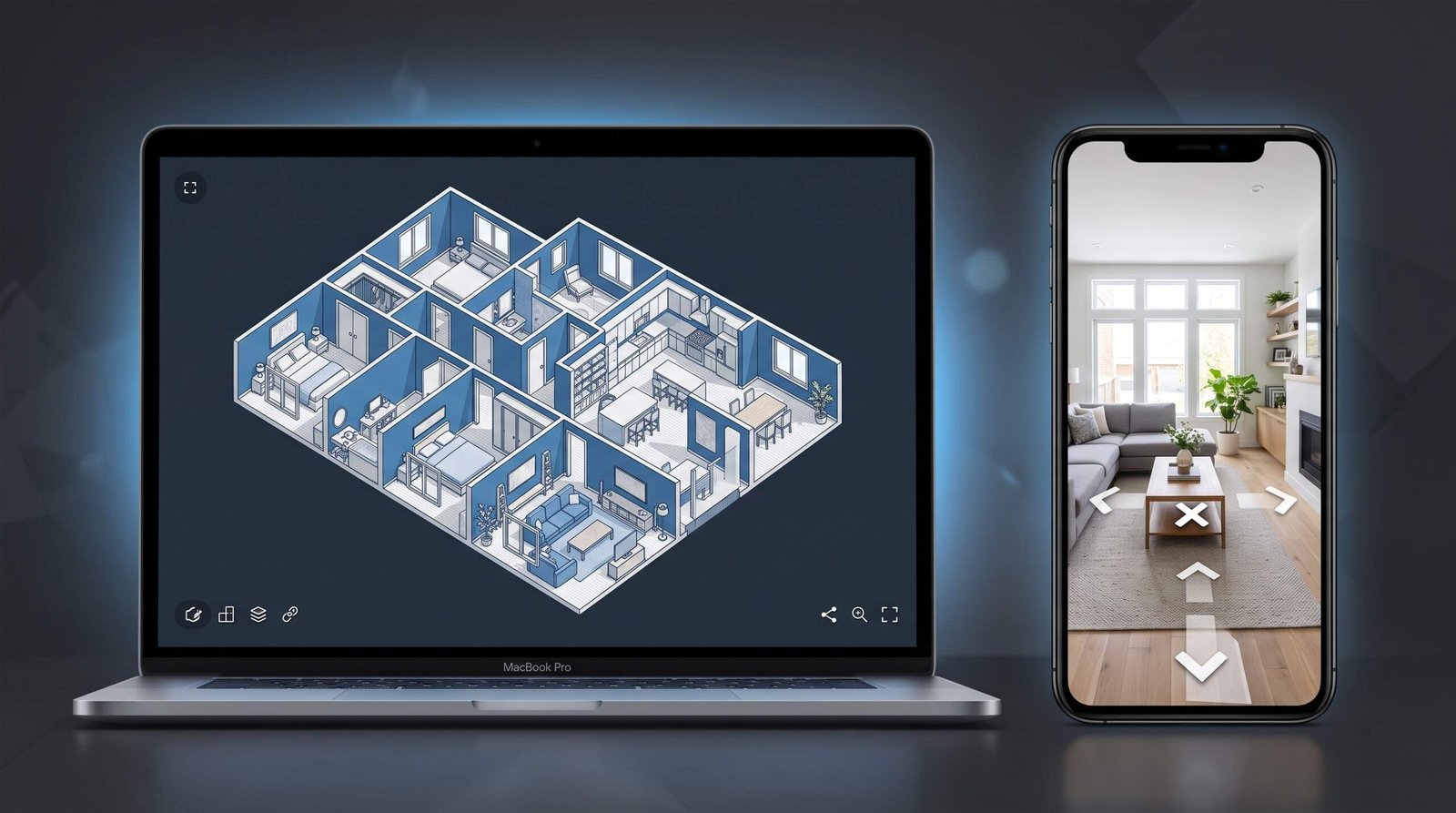
Matterport structures its pricing around subscription tiers keyed to how many tours you keep live at once. The Starter 5 plan runs $14 per month and holds 5 active spaces. Stepping up, the Professional 30 plan sits at $99 per month for 30 active spaces, and the Professional 50 plan reaches $159 per month for 50 active spaces. You can see the full breakdown on the Matterport subscription plans page. The tier you need depends entirely on how many real estate 3d tour listings you host simultaneously, not how many you shoot in total.
That phrase, “active spaces,” is the single most important concept for pricing, and most new photographers miss it. An active space is any tour currently live and hosted on your account. When a listing sells and the tour comes down, that space frees up for the next job. So your Matterport bill is not a one-time cost per tour; it is an ongoing hosting cost you carry for as long as each tour stays published. If you host 30 tours at once on the $99 plan, your hosting cost is $3.30 per space per month. Build that number into your pricing and you protect your margin. Ignore it and you can quietly lose money on high-volume months.
The alternatives sidestep the subscription math in different ways. iGUIDE charges roughly $75 per scan with no monthly fee and includes ANSI-standard floor plans, which suits photographers who shoot in bursts and hate recurring bills. Zillow 3D Home is free and syncs straight to Zillow listings using just a smartphone, making it the obvious sandbox for learning. Asteroom, at $12 to $24 per month, is the budget-friendly middle ground and even works with a DSLR plus a rotating adapter.
Here is our practical advice for anyone new: start with Zillow 3D Home or Asteroom before you commit to Matterport hardware. Both let you test whether the agents in your market actually want 3D tours, and both cost little or nothing. Once you have paying clients asking for tours regularly, the economics of a Ricoh Theta Z1 on Matterport, or eventually a Pro3, make sense. Buy the ecosystem after you have proven the demand, not before.
How to Price 3D Real Estate Photography
Price your tours in tiers so agents can self-select by listing value. Here is a three-package structure that works across most markets.
| Package | What’s Included | Typical Price Range |
|---|---|---|
| Starter | Interactive 3D tour (hosted 30 days), embed link, up to 1,500 sq ft | $75-$150 |
| Standard | 3D tour (hosted 90 days), HD download option, schematic floor plan, up to 2,500 sq ft | $150-$250 |
| Premium | 3D tour (hosted 1 year), branded tour with agent logo, HDR photo bundle + 3D, any size | $300-$600+ |
Now the profitability math, because pricing without knowing your cost floor is guessing. Say you run the Matterport Professional 30 plan at $99 per month and keep all 30 active spaces filled. That works out to $3.30 per space per month in hosting overhead. Even if a Starter tour stays live for its full 30 days, your hosting cost on it is about $3.30. Charge $150 per tour as your minimum and your margin is enormous; the real cost is your time and travel, not the platform. This is why we suggest a $150 floor even on smaller homes: it keeps every job comfortably profitable while leaving room to discount for volume clients.
Market matters, and it matters a lot. In NYC, San Francisco, or LA, where listing prices and agent budgets run high, the same Premium package that fetches $400 in a secondary market can command $600 or more, and agents will still consider it a bargain against a multimillion-dollar listing. In smaller and secondary markets, temper expectations: a $150 Standard tour may be your bread and butter, and pushing much past $300 gets harder unless the listing is genuinely luxury. Read your market, price to it, and revisit your rates as you build a reputation.
The strongest upsell is bundling. When an agent books a 3D tour, offer to pair it with a twilight shoot of the exterior for a package rate. Twilight images are the single most eye-catching photo in any listing, and combining them with an immersive tour gives the agent a premium marketing set in one appointment. Our guide to twilight real estate photography covers how to shoot and price that add-on, and stacking it onto a 3D booking can lift a $200 job to a $450 one without a second trip.
The 3D Real Estate Photography Workflow
Equipment Checklist
Before you leave for a shoot, confirm you have the essentials packed. A missing battery or an unstable tripod can cost you a re-shoot.
- Camera and a low, stable tripod. 3D cameras must be precisely leveled, so a tripod with a reliable head is non-negotiable.
- Extra batteries. A full-home scan drains power faster than you expect, and swapping batteries beats aborting a shoot.
- A laptop or tablet for on-site processing, previewing captures, and catching gaps before you pack up.
- A power strip for longer shoots, so you can charge gear and run your laptop without hunting for outlets.
Pre-Shoot Preparation
Prep separates a clean tour from an embarrassing one. Unlike a still photo where you frame out the mess, a 3D tour captures the entire room in every direction, so nothing hides. Walk the home first and declutter aggressively: clear countertops, tuck away personal items and family photos, and remove anything that dates or personalizes the space. Close every toilet lid. Adjust window treatments to a consistent, open position so the tour reads bright and uniform.
Then plan your route. Scout the shoot order before you place the first tripod position, because 3D capture builds sequentially and backtracking wastes time. A reliable sequence for a typical home is main floor first, then the upper floor, then the basement, and finally the exterior. Time your exterior capture for even outdoor light rather than harsh midday sun, and let the interior order flow logically room to room so the finished tour navigates the way a person would actually walk.
Shooting Sequence and Best Practices
The single biggest technical factor in a clean tour is position overlap. Place your scan positions roughly 3 to 4 feet apart so the software has enough shared detail to align them cleanly. Too far apart and the tour develops gaps and misalignments; too close and you waste time with redundant captures. For a typical 1,500 square foot home, plan on 10 to 15 positions to cover the space thoroughly.
A few habits keep your captures professional. Stay out of frame; since the camera sees 360 degrees, you cannot simply stand behind it, so step out of the room or tuck around a corner during each capture. Watch for mirrors, which confuse both LiDAR and photographic stitching and can create ghostly artifacts. When you move to exterior scans, use the weather to your advantage: overcast or dull light is ideal because it delivers even exposure without blown-out skies or deep shadows. A gray day that frustrates a landscape photographer is a gift to a 3D shooter.
Processing and Delivery
Once you upload, the heavy lifting is automated. Matterport auto-processes a scan in roughly 20 to 30 minutes after upload, stitching positions, generating the dollhouse view, and building the floor plan without your involvement. Use that window to review your capture on-site so you can rescan a problem room before leaving.
For delivery, send the agent everything they need to market immediately: the embed code for their website, a shareable URL for social and email, a floor plan PDF, and any HDR still images you pulled from the panoramas. Set the tour’s expiration to match the package tier the agent bought, whether that is 30 days, 90 days, or a full year, and note the takedown date in your own calendar so you free up that active space when the listing sells. For the composition and lighting fundamentals that make the HDR stills in your tour shine, see our real estate photography tips.
3D Real Estate Photography vs Standard Photography: When to Recommend Each
Not every listing needs a 3D tour, and part of your value to an agent is knowing when to advise one and when to save them the money. Use this table as a starting framework.
| Scenario | Standard Photos | 3D Tour | Both |
|---|---|---|---|
| Under $300K listing, quick sale market | ✓ | – | Optional |
| Over $500K listing or luxury property | ✓ | ✓ | ✓ |
| Out-of-state or relocation buyer expected | – | ✓ | ✓ |
| New construction / vacant home | ✓ | ✓ | Best option |
| Condo with limited square footage | ✓ | Optional | – |
The decision framework is straightforward once you internalize it. For a modestly priced home in a market where listings sell in days, standard photos usually do the job, and pushing a 3D tour can feel like overselling. For anything over $500K or genuinely luxury, both stills and a tour are the expectation, not the upgrade. When the agent tells you a relocation or out-of-state buyer is likely, the 3D tour becomes essential, since that buyer may never see the home in person before making a decision. New construction and vacant homes are ideal 3D candidates because they photograph cleanly and often serve buyers who are still visualizing the space. Small condos are the one case where a tour may add little, because the space is easy to grasp from a handful of photos. Advise honestly, and agents will trust your upsells when they do come.
Getting Your First 3D Real Estate Photography Clients
Start where you already have trust. Your existing photography clients are the fastest path to your first 3D bookings, so offer a 3D tour as a free add-on on their next shoot. The cost to you is minimal, especially on a free platform, and once an agent sees the listing engagement a tour drives, they will pay for it on the next property. One free demo often converts into a recurring line item.
Next, aim upmarket. Target agents who handle luxury listings, because they have both the budget and the expectation for 3D. These are the clients who move you from $150 tours to $400 packages, and they talk to other luxury agents. Landing two or three of them can reshape your whole revenue picture.
To sell a tour, you need a tour to show. Shoot your own home or a friend’s place to build a polished sample, then embed that live, interactive tour prominently on your website so prospective clients can experience the product rather than just read about it. A single strong sample tour does more selling than any pitch. For the bigger picture on building your book of business, from pricing to client acquisition to scaling, see our guide to starting and growing a real estate photography business.
Frequently Asked Questions
How much does 3D real estate photography cost for agents?
Agents typically pay $75 to $300 for a 3D tour as an add-on, though luxury packages that bundle branded tours, floor plans, and HDR photography run $300 to $600 or more. The price depends on property size, hosting duration, and the market. In high-cost metros like NYC, San Francisco, and LA, agents pay at the top of these ranges and consider it a bargain against a high-value listing. In secondary markets, a $150 tour is common. The fee usually covers the interactive tour, a shareable link, and hosting for a set period, often 30 to 90 days, with floor plans and photo bundles priced into higher tiers. Agents view this as a marketing investment, since tours drive engagement and can shorten time on market, so most fold the cost into their listing package rather than passing it to sellers directly.
How long does a 3D real estate photography shoot take?
A typical 1,500 square foot home takes 30 to 60 minutes to scan on-site, depending on your camera and the number of positions. With a fast LiDAR device like the Matterport Pro3, you might finish a mid-size home in half an hour; with a 360 camera capturing HDR panoramas at each of 10 to 15 positions, expect closer to an hour. Larger homes scale up from there, and cluttered spaces slow you down because every room must be captured in full. Add prep time for decluttering and staging, which the agent or homeowner ideally handles before you arrive. Processing is largely hands-off: Matterport auto-processes a scan in roughly 20 to 30 minutes after upload. The efficient move is to scan the 3D tour during the same appointment as your standard photos, so a combined shoot rarely adds more than 30 to 45 minutes to your on-site time.
Do I need a Matterport camera to offer 3D tours?
No. Matterport is the best-known name, but you can offer professional 3D tours with far cheaper gear. A Ricoh Theta Z1, around $1,000, works with Matterport, iGUIDE, Zillow 3D Home, and most other platforms, giving you flexibility without the Pro3’s $5,995 price tag. Budget options like the Insta360 RS 1-inch at $649 or the GoPro Max at $399 let you start for even less. You can even begin with a recent iPhone Pro’s built-in LiDAR sensor and a free app like Zillow 3D Home, which costs nothing if you already own the phone. We suggest new photographers test demand with a free or low-cost platform before investing in Matterport hardware. Buy into the Matterport ecosystem once you have paying clients who specifically request it, not before you have proven the market wants tours at all.
How much should I charge for 3D real estate photography services?
Set a floor of $150 per tour and tier up from there. A Starter package with a 30-day hosted tour on a home up to 1,500 square feet fits the $75 to $150 range; a Standard package with a 90-day tour, floor plan, and download option lands at $150 to $250; and a Premium package with a year of hosting, branding, and an HDR photo bundle commands $300 to $600 or more. Base your floor on your true cost. On a Matterport Professional 30 plan at $99 per month hosting 30 active spaces, your overhead is just $3.30 per space per month, so at $150 per tour your margin is strong and the real cost is your time. Adjust upward in high-cost metros and for luxury listings, and lean on bundling, pairing a tour with a twilight shoot, to raise your average ticket without adding a second appointment.
What is the difference between 3D real estate photography and virtual staging?
They solve different problems. 3D real estate photography captures a real, existing space so buyers can navigate an interactive walkthrough of how the property actually looks right now. Virtual staging, by contrast, digitally adds furniture and decor to photos of an empty room, showing buyers how a vacant space could look once furnished. One documents reality; the other visualizes potential. A 3D tour of a vacant home shows bare rooms, which can feel cold, so some photographers pair the two, delivering an immersive tour alongside virtually staged still photos that help buyers imagine living there. They are complementary services, not competitors, and offering both lets you serve a vacant listing completely: the tour proves the layout and condition, while the staged photos sell the lifestyle. Just be transparent that staged images are enhancements, since MLS rules require disclosure of virtually staged photos.
Is the Matterport Pro3 worth it for real estate photographers?
The Pro3 is worth it for high-volume professionals who shoot 3D tours regularly and are committed to the Matterport ecosystem, but it is overkill for most photographers starting out. At roughly $5,995 plus an ongoing Matterport subscription, it only pays off once you are booking tours consistently enough to justify the outlay. What you get is genuine LiDAR accuracy, dramatically faster scan times than a 360 camera, and seamless integration with the platform agents already recognize and trust. The tradeoff is the walled garden: the Pro3 works only with Matterport, so you lose the flexibility to serve agents who prefer iGUIDE, Zillow, or another platform. Our advice is to prove demand first with a Ricoh Theta Z1 or a free platform, then step up to a Pro3 once 3D is a steady, profitable line of your business. For a full-time photographer running 20-plus tours a month, the speed and quality justify the investment. For a beginner, it does not.
What camera do most real estate photographers use for virtual tours?
Most working real estate photographers land on one of two tiers. High-volume professionals committed to Matterport use the Matterport Pro3, which delivers LiDAR accuracy and fast scans within the platform agents know best. The far more common choice for everyone else is the Ricoh Theta Z1, around $1,000, because its 1-inch sensors produce clean HDR panoramas and it works across Matterport, iGUIDE, Zillow 3D Home, and most other platforms. That cross-platform flexibility makes the Z1 the pragmatic default for photographers who want quality without locking into a single ecosystem. Budget-minded shooters and beginners often start with the Insta360 RS 1-inch at $649 or even a smartphone with LiDAR paired with a free app. In practice, the Ricoh Theta Z1 is the camera you will see most often in the bags of photographers who take 3D seriously but have not gone all-in on the Matterport Pro3.